EcoFlow DELTA 3 Max Plus vs Jackery Explorer 2000 Plus
Specs come from each brand's Australian website and manuals. Each one shows where it came from and how it was measured. Prices are from 5 shops, checked 29 Sept 2026.
If you buy through a link on this page, the retailer may pay us a commission. Affiliate disclosure

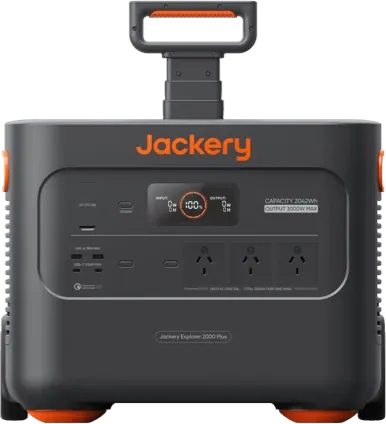
What separates these two
- WeightThe EcoFlow states about 22.1 kg (Unit only The station by itself, without cables, chargers or a bag.); the Jackery states about 27.9 kg (unit only), 26% heavier.This means the EcoFlow is lighter to carry.
Sources
EcoFlow: manufacturer page (au.ecoflow.com) read 29 Sept 2026
Approx. 22.1 kg
Jackery: manufacturer document (r.jackery.net) read 29 Sept 2026
About 61.5 lbs/ 27.9 kg
- UPS switchoverThe EcoFlow states up to 10 ms (how it was tested not stated); the Jackery states up to 20 ms (how it was tested not stated), 10 ms slower.This means the EcoFlow switches to its own battery faster when the mains power it's plugged into cuts out.
Sources
EcoFlow: manufacturer page (au.ecoflow.com) read 29 Sept 2026
<10 ms
Jackery: manufacturer document (r.jackery.net) read 29 Sept 2026
automatically switch to battery mode within 20ms
Price and price per Wh aren't compared here yet. That needs a second shop selling each one for about the same price (within 10%), which shows the price is real. Today: price, EcoFlow $2,999 and Jackery $2,699; price per Wh, EcoFlow 146.4¢ and Jackery 132.1¢.
4 figures are about the same
- Capacity: EcoFlow 2,048 Wh; Jackery 2,043 Wh (less than 10% apart)
- AC output, non-stop: EcoFlow 3,000 W; Jackery 3,000 W (the same)
- 12 V car socket: EcoFlow 10 A; Jackery 10 A (the same)
- Expansion batteries: EcoFlow Yes; Jackery Yes, up to 12,000 Wh in total (the same)
Can't be compared The two brands give this figure in different ways, or only one brand gives it. For example, one counts battery charges until 80% of the capacity is left and the other until 70%. Set side by side, the numbers would mislead, so both are shown and neither is put ahead.
- Solar inputThe Jackery states up to 1,400 W. The brand doesn't give this figure for the EcoFlow.This means the two can't be compared on this until both brands publish it.
Sources
Jackery: manufacturer document (r.jackery.net) read 29 Sept 2026
17.5-60V (Working Voltage)⎓12A Max, Double to 24A/1400W Max
- Wall charging, empty to fullThe EcoFlow states 68 min (no AC charging Charging from a household power point. A fast-mode figure uses the brand's quickest charging setting, so it isn't compared with standard charging. mentioned, full or part charge not stated, charging at 2,300 W). The brand doesn't give this figure for the Jackery.This means the two can't be compared on this until both brands publish it.
Sources
EcoFlow: manufacturer page (au.ecoflow.com) read 29 Sept 2026
2300W (68 min)
- Cycle lifeThe Jackery states 4,000 cycles (until 70% of the original capacity is left). The brand doesn't give this figure for the EcoFlow.This means the two can't be compared on this until both brands publish it.
Sources
Jackery: manufacturer document (r.jackery.net) read 29 Sept 2026
4000 cycles to 70%+ capacity
- Stated warrantyThe EcoFlow states 5 years. The brand doesn't give this figure for the Jackery.This means the two can't be compared on this until both brands publish it.
Sources
EcoFlow: manufacturer page (au.ecoflow.com) read 29 Sept 2026
5 Years
- AC surgeThe EcoFlow states 6,000 W (how long it lasts not stated); the Jackery states 6,000 W (how long it lasts not stated). Neither brand says how long its Surge A short burst above the continuous rating, for appliances that need a kick to start, like a fridge compressor or a power tool. It lasts from a fraction of a second to a few seconds. lasts, so they aren't compared.This means the two numbers were measured in different ways, so setting one against the other would mislead.
Sources
EcoFlow: manufacturer page (au.ecoflow.com) read 29 Sept 2026
6000W
Jackery: manufacturer document (r.jackery.net) read 29 Sept 2026
3000W Max, 6000W surge peak
A difference is listed above only when both brands measure a figure the same way and the gap is at least: capacity: 10% or more; price: 10% or more; price per Wh: 10% or more; AC output, non-stop: 15% or more; weight: 8% or more; 12 V car socket: any difference; solar input: 20% or more; wall charging, empty to full: 20% or more; cycle life: 20% or more; stated warranty: any difference; UPS switchover: 5 ms or more; expansion batteries: one has it and the other doesn't; AC surge: 15% or more. Every comparison on this site uses the same gaps.
Fridge runtime for both
How long each would run an example fridge, a Dometic CFX5 45, with no solar and no driving. Its manufacturer says it uses 0.76 Ah an hour at 12 V when it is 32 °C outside and 4 °C inside. The brands don't publish some of the figures this needs. Where someone has tested the station, their result is used; otherwise both use the same ranges, taken from tests of other stations. For the EcoFlow, tests of this exact station give its own draw (measured by The Technology Man) and Share delivered How much of the capacity on the box actually comes out of a socket, as a percentage. Testers run a steady load until the station switches off and count what came out. The rest is kept back to protect the battery or lost as heat making 12 V or 240 V. (measured by The Technology Man).
The middle estimates are 19 hours apart.This means the Jackery is likely to run the fridge for longer, but that one unknown figure could close the gap.
The biggest unknown is the Station's own draw Power the station uses itself while an outlet is switched on: its screen, its electronics and the circuit that makes 12 V or 240 V. Few brands publish it. Over 24 hours it can add up to as much as a small fridge uses. with the 12 V car socket A cigarette-lighter style socket that runs 12 V gear, like a camping fridge, directly. Its rating is in amps (A): a 10 A socket supplies up to about 120 W. on. No brand publishes it and no test of this station was found, so 1–12 W is assumed. On its own, it can change the Jackery's answer by up to 3.5 days, which is more than the gap between the two.
Try another fridge, add solar or driving, or change the assumed ranges:
Loading the runtime tool…
Charging paths
| Path | EcoFlow DELTA 3 Max Plus | Jackery Explorer 2000 Plus |
|---|---|---|
| Wall (AC) | Charging input: 2,300 W (charging mode not stated) Sourcemanufacturer page (au.ecoflow.com) read 29 Sept 2026 Charging time: 68 min (charging mode not stated; full or part charge not stated; charging at 2,300 W) Sourcemanufacturer page (au.ecoflow.com) read 29 Sept 2026 | not stated |
| Car charging | not stated | not stated |
| Solar | not stated | Maximum input: up to 1,400 W (condition not stated) Sourcemanufacturer document (r.jackery.net) read 29 Sept 2026 |
| Expansion batteries Extra batteries made to plug into this station to add capacity. | Takes them: Yes Sourcemanufacturer page (au.ecoflow.com) read 29 Sept 2026 | Takes them: Yes Sourcemanufacturer page (au.jackery.com) read 29 Sept 2026 Total with them: up to 12,000 Wh (with extra batteries added; which ones not stated) Sourcemanufacturer page (au.jackery.com) read 29 Sept 2026 |
“Not stated” means the brand's website and manual don't give that figure (checked 29 Sept 2026).
All the specs side by side
| Figure | EcoFlow DELTA 3 Max Plus | Jackery Explorer 2000 Plus |
|---|---|---|
| Capacity and battery | ||
| Capacity | 2,048 Wh (Nameplate capacity The capacity printed on the box, in watt-hours (Wh): what the battery holds when new. You get less out of it in use, because the station keeps some back to protect the battery and loses some turning it into 240 V or 12 V power., Usable capacity How much of the box capacity you can actually draw out. Most brands don't publish it, so the box figure is the only one that can be compared. not stated)Sourcemanufacturer page (au.ecoflow.com) read 29 Sept 2026 | 2,043 Wh (Nameplate capacity The capacity printed on the box, in watt-hours (Wh): what the battery holds when new. You get less out of it in use, because the station keeps some back to protect the battery and loses some turning it into 240 V or 12 V power., Usable capacity How much of the box capacity you can actually draw out. Most brands don't publish it, so the box figure is the only one that can be compared. not stated)Sourcemanufacturer document (r.jackery.net) read 29 Sept 2026 |
| Battery type The type of cells inside the battery. Most power stations now use LiFePO4; NCM, short for nickel cobalt manganese, is the other type that turns up. | LiFePO4 Lithium iron phosphate, the battery type most power stations now use. Battery boxes sometimes call it "lithium".Sourcemanufacturer page (au.ecoflow.com) read 29 Sept 2026 | LiFePO4 Lithium iron phosphate, the battery type most power stations now use. Battery boxes sometimes call it "lithium".Sourcemanufacturer page (au.jackery.com) read 29 Sept 2026 |
| Cycle life How many full charges before the battery drops to a set share of its original capacity, usually 70% or 80%. 4,000 cycles to 80% is a higher bar than 4,000 cycles to 70%. The table's column counts cycles to 80% only. | not stated | 4,000 cycles (until 70% of the original capacity is left)Sourcemanufacturer document (r.jackery.net) read 29 Sept 2026 |
| Expansion batteries Extra batteries made to plug into this station to add capacity. | YesSourcemanufacturer page (au.ecoflow.com) read 29 Sept 2026 | YesSourcemanufacturer page (au.jackery.com) read 29 Sept 2026 |
| Ah at 12.8 V Capacity in amp-hours, the way a 12 V lithium battery box states it, so the two can be compared. Worked out from the Wh figure: Wh ÷ 12.8. | 160 Ah derived: 2,048 Wh nameplate ÷ 12.8 V = 160 Ah | 159.6 Ah derived: 2,043 Wh nameplate ÷ 12.8 V = 159.6 Ah |
| Price per Wh The price divided by the capacity on the box, in cents (¢) per watt-hour (Wh). Lower means more capacity for the money. | 146.4¢ derived: $2,999 (price today) ÷ 2,048 Wh nameplate = 146.4¢ per Wh | 132.1¢ derived: $2,699 (price today) ÷ 2,043 Wh nameplate = 132.1¢ per Wh |
| Expansion batteries Extra batteries made to plug into this station to add capacity. | not stated | up to 12,000 Wh (with extra batteries added; which ones not stated)Sourcemanufacturer page (au.jackery.com) read 29 Sept 2026 |
| Output | ||
| AC output The household-style power points on the station, for things you'd normally plug into a wall. The figure is the continuous rating in watts (W): the most the station can supply non-stop. | 3,000 W (Continuous output The power the station can supply non-stop. This is the figure that decides which appliances it can run, like a 1,000 W microwave., AC, taken as non-stop, because the brand lists a separate Surge A short burst above the continuous rating, for appliances that need a kick to start, like a fridge compressor or a power tool. It lasts from a fraction of a second to a few seconds. figure)Sourcemanufacturer page (au.ecoflow.com) read 29 Sept 2026 | 3,000 W (Continuous output The power the station can supply non-stop. This is the figure that decides which appliances it can run, like a 1,000 W microwave., AC, taken as non-stop, because the brand lists a separate Surge A short burst above the continuous rating, for appliances that need a kick to start, like a fridge compressor or a power tool. It lasts from a fraction of a second to a few seconds. figure)Sourcemanufacturer document (r.jackery.net) read 29 Sept 2026 |
| Surge A short burst above the continuous rating, for appliances that need a kick to start, like a fridge compressor or a power tool. It lasts from a fraction of a second to a few seconds. | 6,000 W (surge, AC, how long it lasts not stated)Sourcemanufacturer page (au.ecoflow.com) read 29 Sept 2026 | 6,000 W (surge, AC, how long it lasts not stated)Sourcemanufacturer document (r.jackery.net) read 29 Sept 2026 |
| Boost or lifting mode A mode that lets higher-power appliances, like a kettle, run by lowering the voltage they get, so they run slower or weaker. It isn't a surge rating. | 3,900 W (AC, Max Output by X-Boost mode, not a Surge A short burst above the continuous rating, for appliances that need a kick to start, like a fridge compressor or a power tool. It lasts from a fraction of a second to a few seconds. rating)Sourcemanufacturer page (au.ecoflow.com) read 29 Sept 2026 | not stated |
| 12 V car socket A cigarette-lighter style socket that runs 12 V gear, like a camping fridge, directly. Its rating is in amps (A): a 10 A socket supplies up to about 120 W. | 10 A (12 V, at 12.6 V)Sourcemanufacturer page (au.ecoflow.com) read 29 Sept 2026 | 10 A (12 V)Sourcemanufacturer document (r.jackery.net) read 29 Sept 2026 |
| USB-A and USB-C ports USB-A is the older, flat rectangular socket on phone chargers; USB-C is the small oval one on newer phones and laptops. Some USB-C ports put out enough power to charge a laptop. | 3Sourcemanufacturer page (au.ecoflow.com) read 29 Sept 2026 | not stated |
| USB-A and USB-C ports USB-A is the older, flat rectangular socket on phone chargers; USB-C is the small oval one on newer phones and laptops. Some USB-C ports put out enough power to charge a laptop. | 1Sourcemanufacturer page (au.ecoflow.com) read 29 Sept 2026 | not stated |
| UPS switchover UPS stands for uninterruptible power supply: with the station plugged in, it takes over when the mains power cuts out, so a device stays on. Switchover is how quickly, in milliseconds (ms); smaller is quicker. The brands don't say what load they tested with. | up to 10 ms (how it was tested not stated)Sourcemanufacturer page (au.ecoflow.com) read 29 Sept 2026 | up to 20 ms (how it was tested not stated)Sourcemanufacturer document (r.jackery.net) read 29 Sept 2026 |
| Charging | ||
| AC charging Charging from a household power point. A fast-mode figure uses the brand's quickest charging setting, so it isn't compared with standard charging. | 68 min (charging mode not stated; full or part charge not stated; charging at 2,300 W)Sourcemanufacturer page (au.ecoflow.com) read 29 Sept 2026 | not stated |
| AC charging Charging from a household power point. A fast-mode figure uses the brand's quickest charging setting, so it isn't compared with standard charging. | 2,300 W (charging mode not stated)Sourcemanufacturer page (au.ecoflow.com) read 29 Sept 2026 | not stated |
| Solar input The most solar power the station can take in. Panels also have to fall inside the stated voltage range, or the station won't charge from them. | not stated | up to 1,400 W (condition not stated)Sourcemanufacturer document (r.jackery.net) read 29 Sept 2026 |
| Size and weight | ||
| Weight | about 22.1 kg (Unit only The station by itself, without cables, chargers or a bag.)Sourcemanufacturer page (au.ecoflow.com) read 29 Sept 2026 | about 27.9 kg (Unit only The station by itself, without cables, chargers or a bag.)Sourcemanufacturer document (r.jackery.net) read 29 Sept 2026 |
| Size (as stated) | 494 × 242 × 305 mm (Unit only The station by itself, without cables, chargers or a bag.)Sourcemanufacturer page (au.ecoflow.com) read 29 Sept 2026 | 473 × 359 × 374 mm (Unit only The station by itself, without cables, chargers or a bag.)Sourcemanufacturer document (r.jackery.net) read 29 Sept 2026 |
| Wh per kg Capacity for each kilogram carried. Higher means lighter for the capacity. | 93 Wh/kg derived: 2,048 Wh nameplate ÷ 22.1 kg (unit only) = 93 Wh per kg | 73 Wh/kg derived: 2,043 Wh nameplate ÷ 27.9 kg (unit only) = 73 Wh per kg |
| Warranty | ||
| Stated warranty The warranty the brand's own Australian store states. Some brands add years if the product is registered. | 5 years (the brand's Australian store)Sourcemanufacturer page (au.ecoflow.com) read 29 Sept 2026 | not stated |
Capacity is the nameplate figure in watt-hours (Wh), the one on the box. AC output is the power a station can supply non-stop, not a short burst. Weight is the station on its own. A figure measured another way is shown with a note saying how, and isn't compared with the others.
Where this pair sits
these twoother power stationsmiddle price per Wh
The same as a table
| Power station | Capacity | Price today | Price per Wh |
|---|---|---|---|
| Anker SOLIX C1000 Gen 2 | 1,024 Wh | $999 | 97.6¢ |
| BLUETTI Elite 100 V2 | 1,024 Wh | $949 | 92.7¢ |
| EcoFlow DELTA 3 Classic | 1,024 Wh | $1,199 | 117.1¢ |
| EcoFlow DELTA 3 Plus | 1,024 Wh | $1,599 | 156.2¢ |
| Jackery Explorer 1000 v2 | 1,070 Wh | $699 | 65.3¢ |
| Jackery Explorer 1000 Plus | 1,264 Wh | $1,659 | 131.3¢ |
| EcoFlow DELTA 3 (1500) | 1,536 Wh | $1,783 | 116.1¢ |
| Jackery Explorer 1500 Ultra | 1,536 Wh | $1,549 | 100.8¢ |
| Jackery Explorer 2000 Plus | 2,043 Wh | $2,699 | 132.1¢ |
| Anker SOLIX C2000 Gen 2 | 2,048 Wh | $1,799 | 87.8¢ |
| EcoFlow DELTA 2 Max (2048) | 2,048 Wh | $2,341 | 114.3¢ |
| EcoFlow DELTA 3 Max Plus | 2,048 Wh | $2,999 | 146.4¢ |
| BLUETTI Elite 200 V2 | 2,074 Wh | $1,899 | 91.6¢ |
| BLUETTI Apex 300 | 2,765 Wh | $2,799 | 101.2¢ |
| BLUETTI Elite 300 | 3,014 Wh | $2,699 | 89.5¢ |
| Anker SOLIX F3000 | 3,072 Wh | $2,799 | 91.1¢ |
| EcoFlow DELTA 3 Ultra Plus | 3,072 Wh | $3,899 | 126.9¢ |
| EcoFlow DELTA Pro | 3,600 Wh | $2,849 | 79.1¢ |
| Anker SOLIX F3800 | 3,840 Wh | $3,799 | 98.9¢ |
| BLUETTI Elite 400 | 3,840 Wh | $3,099 | 80.7¢ |
Price record
EcoFlow DELTA 3 Max Plus
Recorded 27 Sept 2026 to 29 Sept 2026, 4 retailers. In stock at $2,999 (Caravan RV Camping, from 29 Sept).
Every recorded change as a table
| Date | Retailer | Price | Stock |
|---|---|---|---|
| 27 Sept 2026 | EcoFlow | $2,999 | |
| 27 Sept 2026 | My Generator | $2,999 | |
| 28 Sept 2026 | Anaconda | $2,999 | in stock |
| 28 Sept 2026 | Caravan RV Camping | $2,999 | |
| 29 Sept 2026 | Caravan RV Camping | $2,999 | in stock |
| 29 Sept 2026 | EcoFlow | $2,999 | in stock |
| 29 Sept 2026 | My Generator | $2,999 | in stock |
Every price move across power stations: price log.
Jackery Explorer 2000 Plus
Every price
What each shop charges for the station on its own, cheapest first. Kits (the station sold with extras, like a solar panel) are on each product's page and don't count here.
EcoFlow DELTA 3 Max Plus
| AnacondaIn stock · checked 29 Sept 2026 | $2,999 | Check price |
| Caravan RV CampingIn stock · checked 29 Sept 2026 | $2,999 | Check price |
| EcoFlowIn stock · checked 29 Sept 2026 | $2,999 | Check price |
| My GeneratorIn stock · checked 29 Sept 2026 | $2,999 | Check price |
Jackery Explorer 2000 Plus
| JackeryIn stock · checked 29 Sept 2026 | $2,699 | Check price |
2 kits with the Explorer 2000 Plus, on its page.
What neither brand tells you
These figures would help answer the questions above, but neither brand gives them (checked 29 Sept 2026):
- Usable capacity How much of the box capacity you can actually draw out. Most brands don't publish it, so the box figure is the only one that can be compared.: how much of the Nameplate capacity The capacity printed on the box, in watt-hours (Wh): what the battery holds when new. You get less out of it in use, because the station keeps some back to protect the battery and loses some turning it into 240 V or 12 V power. you can actually use. The fridge runtime above uses test results for how much comes out of the socket instead.
- The Station's own draw Power the station uses itself while an outlet is switched on: its screen, its electronics and the circuit that makes 12 V or 240 V. Few brands publish it. Over 24 hours it can add up to as much as a small fridge uses. with the 12 V car socket A cigarette-lighter style socket that runs 12 V gear, like a camping fridge, directly. Its rating is in amps (A): a 10 A socket supplies up to about 120 W. on: the fridge runtime above uses a test of the station if one was found, otherwise a range of 1–12 W.
- How much of the capacity comes out of the 12 V car socket A cigarette-lighter style socket that runs 12 V gear, like a camping fridge, directly. Its rating is in amps (A): a 10 A socket supplies up to about 120 W.: the fridge runtime above uses a test of the station if one was found, otherwise a range of 75–92%.
- How long the Surge A short burst above the continuous rating, for appliances that need a kick to start, like a fridge compressor or a power tool. It lasts from a fraction of a second to a few seconds. lasts: without it, two Surge A short burst above the continuous rating, for appliances that need a kick to start, like a fridge compressor or a power tool. It lasts from a fraction of a second to a few seconds. figures can't be compared.
Each product's own page: EcoFlow DELTA 3 Max Plus · Jackery Explorer 2000 Plus.