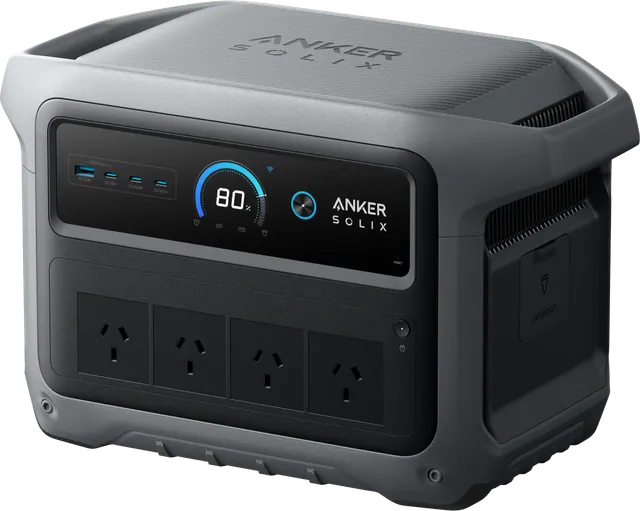
Anker SOLIX C1000 Gen 2
Lithium (LiFePO4) power station, 1,024 Wh nameplate. 3 current prices from 3 Australian retailers, checked 18 Nov 2026. 11 kits listed separately.
If you buy through a link on this page, the retailer may pay us a commission. Affiliate disclosure
Prices
| Anker SOLIXIn stock · checked 18 Nov 2026 | $899 | Check price |
| Caravan RV CampingIn stock · checked 18 Nov 2026 | $899 | Check price |
| My GeneratorIn stock · checked 18 Nov 2026 | $899 | Check price |
Cheapest in-stock price in green.
Key specs
Capacity and battery
- Capacity
- 1,024 Wh (Nameplate capacity The capacity printed on the box, in watt-hours (Wh): what the battery holds when new. You get less out of it in use, because the station keeps some back to protect the battery and loses some turning it into 240 V or 12 V power., Usable capacity How much of the box capacity you can actually draw out. Most brands don't publish it, so the box figure is the only one that can be compared. not stated)
Source
manufacturer page (www.ankersolix.com) read 29 Sept 2026
1,024Wh
- Battery type The type of cells inside the battery. Most power stations now use LiFePO4; NCM, short for nickel cobalt manganese, is the other type that turns up.
- LiFePO4 Lithium iron phosphate, the battery type most power stations now use. Battery boxes sometimes call it "lithium".
Source
manufacturer page (au.ankersolix.com) read 29 Sept 2026
After 4,000 cycles, the LFP battery still retains at least 80% capacity.
- Cycle life How many full charges before the battery drops to a set share of its original capacity, usually 70% or 80%. 4,000 cycles to 80% is a higher bar than 4,000 cycles to 70%. The table's column counts cycles to 80% only.
- 4,000 cycles (until 80% of the original capacity is left)
Source
manufacturer page (au.ankersolix.com) read 29 Sept 2026
After 4,000 cycles, the LFP battery still retains at least 80% capacity.
- Expansion batteries Extra batteries made to plug into this station to add capacity.
- No
Source
manufacturer page (www.ankersolix.com) read 29 Sept 2026
No
- Ah at 12.8 V Capacity in amp-hours, the way a 12 V lithium battery box states it, so the two can be compared. Worked out from the Wh figure: Wh ÷ 12.8.
- 80 Ah derived: 1,024 Wh nameplate ÷ 12.8 V = 80 Ah
- Price per Wh The price divided by the capacity on the box, in cents (¢) per watt-hour (Wh). Lower means more capacity for the money.
- 88¢ derived: $899 (price today) ÷ 1,024 Wh nameplate = 87.8¢ per Wh
Output
- AC output The household-style power points on the station, for things you'd normally plug into a wall. The figure is the continuous rating in watts (W): the most the station can supply non-stop.
- 2,000 W (Continuous output The power the station can supply non-stop. This is the figure that decides which appliances it can run, like a 1,000 W microwave., AC, taken as non-stop, because the brand lists a separate Surge A short burst above the continuous rating, for appliances that need a kick to start, like a fridge compressor or a power tool. It lasts from a fraction of a second to a few seconds. figure)
Source
manufacturer page (au.ankersolix.com) read 29 Sept 2026
2,000W Output via 9 Ports: Delivers 2,000W output, 3,000W peak, and 1,024Wh capacity.
- Surge A short burst above the continuous rating, for appliances that need a kick to start, like a fridge compressor or a power tool. It lasts from a fraction of a second to a few seconds.
- 3,000 W (surge, AC, how long it lasts not stated)
Source
manufacturer page (au.ankersolix.com) read 29 Sept 2026
2,000W Output via 9 Ports: Delivers 2,000W output, 3,000W peak, and 1,024Wh capacity.
- 12 V car socket A cigarette-lighter style socket that runs 12 V gear, like a camping fridge, directly. Its rating is in amps (A): a 10 A socket supplies up to about 120 W.
- 10 A (12 V)
Source
manufacturer document (dix7fd4yse9rd.cloudfront.net) read 29 Sept 2026
12V 10A
- UPS switchover UPS stands for uninterruptible power supply: with the station plugged in, it takes over when the mains power cuts out, so a device stays on. Switchover is how quickly, in milliseconds (ms); smaller is quicker. The brands don't say what load they tested with.
- 10 ms (how it was tested not stated)
Source
manufacturer page (www.ankersolix.com) read 29 Sept 2026
10 ms
Charging
- AC charging Charging from a household power point. A fast-mode figure uses the brand's quickest charging setting, so it isn't compared with standard charging.
- 49 min (UltraFast mode; empty to full ("full"); charging at 1,600 W)
Source
manufacturer page (au.ankersolix.com) read 29 Sept 2026
49 Min UltraFast Recharging: Fully recharge in just 49 min with upgraded HyperFlash tech (1,600W).
- AC charging Charging from a household power point. A fast-mode figure uses the brand's quickest charging setting, so it isn't compared with standard charging.
- up to 1,200 W (charging mode not stated)
Source
manufacturer page (www.ankersolix.com) read 29 Sept 2026
1,200W Max
- AC charging Charging from a household power point. A fast-mode figure uses the brand's quickest charging setting, so it isn't compared with standard charging.
- 1,600 W (UltraFast Charging mode)
Source
manufacturer page (www.ankersolix.com) read 29 Sept 2026
1,600W
- Solar input The most solar power the station can take in. Panels also have to fall inside the stated voltage range, or the station won't charge from them.
- up to 600 W (11–60 V; limited to 8.2 A at 11–28 V and 14.5 A at 29–60 V)
Source
manufacturer page (www.ankersolix.com) read 29 Sept 2026
11-28v⎓8.2A; 29V-60V⎓14.5A (600W Max)
- Solar input The most solar power the station can take in. Panels also have to fall inside the stated voltage range, or the station won't charge from them.
- 11–60 V
Source
manufacturer page (www.ankersolix.com) read 29 Sept 2026
11-28v⎓8.2A; 29V-60V⎓14.5A (600W Max)
Size and weight
- Weight
- 11.3 kg (Unit only The station by itself, without cables, chargers or a bag.)
Source
manufacturer page (www.ankersolix.com) read 29 Sept 2026
11.29 kg
- Wh per kg Capacity for each kilogram carried. Higher means lighter for the capacity.
- 91 Wh/kg derived: 1,024 Wh nameplate ÷ 11.3 kg (unit only) = 91 Wh per kg
Warranty
- Stated warranty The warranty the brand's own Australian store states. Some brands add years if the product is registered.
- 5 years (the brand's Australian store; the C1000 Gen 2 column)
Source
manufacturer page (www.ankersolix.com) read 2 Oct 2026
Comparison UPS 10 ms 10 ms Warranty 5 Years 5 Years Cycle Life 4,000 Cycles 4,000 Cycles
Its sources don't state its standard (non-fast) AC charging time or size (as stated).
With a Dometic CFX5 45 (example fridge), Middle estimate The answer with every figure the brands don't publish at its middle value: a test of that station where there is one, otherwise the typical result of tests on other stations. The range runs from every one of those figures at its least favourable end to every one at its most favourable. 3.8 days on the 12 V socket (range 3.1 to 4.2 days). Worked out with this station's own draw (measured by The Technology Man) and 12 V share (measured by The Technology Man). Runtime with your own fridge, solar and driving
Solar panels its solar input takes
Its Solar input The most solar power the station can take in. Panels also have to fall inside the stated voltage range, or the station won't charge from them. takes 11 to 60 V. 27 of the panels with a price today fit that range, with 10% to spare at the top for a cold morning. The plug isn't checked.
- BLUETTI SORA 500 (500 W). The SOLIX C1000 Gen 2 gets up to the panel's 500 W rating (its 14.5 A limit × 40.9 V is 593 W).
- EcoFlow 400W Lightweight Portable Solar Panel (400 W). The SOLIX C1000 Gen 2 gets up to the panel's 400 W rating (its 14.5 A limit × 34.5 V is 500 W).
- Renogy 400W Compact Mono Portable Folding Solar Panel (RSP400LSC) (400 W). The SOLIX C1000 Gen 2 gets up to the panel's 400 W rating (its 14.5 A limit × 40 V is 580 W).
- Exotronic 200W 24V Portable Folding Solar Panel (Exo-FP-200-24V) (200 W). The SOLIX C1000 Gen 2 gets up to the panel's 200 W rating (its 14.5 A limit × 39.6 V is 574 W).
- Exotronic 300W Fusion Folding Solar Blanket (Exo-FSB-TCN-300) (300 W). The SOLIX C1000 Gen 2 gets about 181 W: its 8.2 A limit × the panel's 22.1 V working voltage.
- Exotronic 300W Fusion Ultra-Light Folding Solar Panel (Exo-FPL-TCN-300) (300 W). The SOLIX C1000 Gen 2 gets about 181 W: its 8.2 A limit × the panel's 22.1 V working voltage.
The other 21
- Exotronic 200W Fusion Portable Folding Solar Panel (Exo-FP-TCN-200) (200 W). The SOLIX C1000 Gen 2 gets about 179 W: its 8.2 A limit × the panel's 21.8 V working voltage.
- BLUETTI SORA 220 (220 W). The SOLIX C1000 Gen 2 gets about 177 W: its 8.2 A limit × the panel's 21.6 V working voltage.
- Exotronic 200W Fusion Ultra-Light Folding Solar Panel (Exo-FPL-TCN-200) (200 W). The SOLIX C1000 Gen 2 gets about 174 W: its 8.2 A limit × the panel's 21.2 V working voltage.
- BLUETTI PV200 (200 W). The SOLIX C1000 Gen 2 gets about 167 W: its 8.2 A limit × the panel's 20.4 V working voltage.
- Jackery SolarSaga 200W (200 W). The SOLIX C1000 Gen 2 gets about 164 W: its 8.2 A limit × the panel's 20 V working voltage.
- Renogy 220W Lightweight Portable Solar Suitcase (RSP220LSC) (220 W). The SOLIX C1000 Gen 2 gets about 164 W: its 8.2 A limit × the panel's 20 V working voltage.
- Exotronic 200W Portable Folding Solar Panel (Exo-FP-200) (200 W). The SOLIX C1000 Gen 2 gets about 162 W: its 8.2 A limit × the panel's 19.8 V working voltage.
- EcoFlow 160W Lightweight Portable Solar Panel (160 W). The SOLIX C1000 Gen 2 gets about 154 W: its 8.2 A limit × the panel's 18.8 V working voltage.
- Exotronic 200W Fusion Folding Solar Blanket (Exo-FSB-TCN-200) (200 W). The SOLIX C1000 Gen 2 gets about 152 W: its 8.2 A limit × the panel's 18.5 V working voltage.
- Sphere 200W Solar Blanket (500-06262) (200 W). The SOLIX C1000 Gen 2 gets about 150 W: its 8.2 A limit × the panel's 18.3 V working voltage.
- Sphere 300W Solar Blanket (500-06264) (300 W). The SOLIX C1000 Gen 2 gets about 150 W: its 8.2 A limit × the panel's 18.3 V working voltage.
- Renogy 200W Solar Blanket (RPP200SB-SE) (200 W). The SOLIX C1000 Gen 2 gets about 138 W: its 8.2 A limit × the panel's 16.8 V working voltage.
- BLUETTI SORA 130 (130 W). The SOLIX C1000 Gen 2 gets up to the panel's 130 W rating (its 8.2 A limit × 21.6 V is 177 W).
- EcoFlow 110W Lightweight Portable Solar Panel (110 W). The SOLIX C1000 Gen 2 gets up to the panel's 110 W rating (its 8.2 A limit × 19.5 V is 160 W).
- Jackery SolarSaga 100W (100 W). The SOLIX C1000 Gen 2 gets up to the panel's 100 W rating (its 8.2 A limit × 20 V is 164 W).
- Jackery SolarSaga 80W (80 W). The SOLIX C1000 Gen 2 gets up to the panel's 80 W rating (its 8.2 A limit × 22.2 V is 182 W).
- BLUETTI 350W Solar Panel (350 W). It limits the current to 8.2 A or 14.5 A, and the panel's working voltage isn't listed, so the watts it gets aren't worked out.
- BLUETTI PV100 (100 W). It limits the current to 8.2 A or 14.5 A, and the panel's working voltage isn't listed, so the watts it gets aren't worked out.
- Renogy 100W N-type Compact Solar Suitcase (RSP100LSC) (100 W). It limits the current to 8.2 A or 14.5 A, and the panel's working voltage isn't listed, so the watts it gets aren't worked out.
- Renogy 300W N-type Compact Solar Suitcase (RSP300LSC) (300 W). It limits the current to 8.2 A or 14.5 A, and the panel's working voltage isn't listed, so the watts it gets aren't worked out.
- Renogy 400W Solar Blanket (RSP400SB) (400 W). It limits the current to 8.2 A or 14.5 A, and the panel's working voltage isn't listed, so the watts it gets aren't worked out.
The watts are its stated current limit × the panel's listed working voltage, capped at both ratings. Panels with no listed open-circuit voltage aren't checked.
Kits with the SOLIX C1000 Gen 2
Sold with other items, so a kit's price is never the price of the SOLIX C1000 Gen 2 on its own. Ordered by price.
| Anker SOLIX with Water Resistant BagIn stock · checked 18 Nov 2026 | $958 | Check price |
| Anker SOLIX with 100W Solar PanelIn stock · checked 18 Nov 2026 | $1,148 | Check price |
| Caravan RV Camping with 100W Solar PanelIn stock · checked 18 Nov 2026 | $1,148 | Check price |
| My Generator with 100W Solar PanelIn stock · checked 18 Nov 2026 | $1,148 | Check price |
| Anker SOLIX with 200W Solar PanelIn stock · checked 18 Nov 2026 | $1,348 | Check price |
| Anker SOLIX with Alternator ChargerIn stock · checked 18 Nov 2026 | $1,348 | Check price |
| Caravan RV Camping with 200W Solar PanelIn stock · checked 18 Nov 2026 | $1,348 | Check price |
| My Generator with 200W Solar PanelIn stock · checked 18 Nov 2026 | $1,348 | Check price |
| Anker SOLIX with PS400 Bifacial Portable Solar PanelIn stock · checked 18 Nov 2026 | $1,798 | Check price |
| Caravan RV Camping with 400W Solar PanelIn stock · checked 18 Nov 2026 | $1,898 | Check price |
| My Generator with 400W Solar PanelIn stock · checked 18 Nov 2026 | $1,898 | Check price |
Price history
Recorded 22 Sept 2026 to 18 Nov 2026, 3 retailers. Lowest in stock: $899 (Anker SOLIX, 10 Nov); highest: $1,399 (Anker SOLIX, 22 Sept).
Every recorded change as a table
| Date | Retailer | Price | Stock |
|---|---|---|---|
| 22 Sept 2026 | Anker SOLIX | $1,399 | in stock |
| 27 Sept 2026 | My Generator | $999 | |
| 28 Sept 2026 | Caravan RV Camping | $999 | |
| 29 Sept 2026 | Caravan RV Camping | $999 | in stock |
| 29 Sept 2026 | My Generator | $999 | in stock |
| 30 Sept 2026 | Caravan RV Camping | $999 | |
| 30 Sept 2026 | My Generator | $999 | |
| 1 Oct 2026 | Caravan RV Camping | $1,399 | |
| 1 Oct 2026 | My Generator | $1,399 | |
| 10 Oct 2026 | Caravan RV Camping | $1,399 | in stock |
| 10 Oct 2026 | My Generator | $1,399 | in stock |
| 11 Oct 2026 | Caravan RV Camping | $1,399 | |
| 11 Oct 2026 | My Generator | $1,399 | |
| 21 Oct 2026 | Caravan RV Camping | $1,399 | in stock |
| 21 Oct 2026 | My Generator | $1,399 | in stock |
| 22 Oct 2026 | Anker SOLIX | $999 | in stock |
| 22 Oct 2026 | Caravan RV Camping | $1,399 | |
| 22 Oct 2026 | My Generator | $1,399 | |
| 24 Oct 2026 | Caravan RV Camping | $1,099 | |
| 24 Oct 2026 | My Generator | $1,099 | |
| 1 Nov 2026 | Caravan RV Camping | $1,099 | in stock |
| 1 Nov 2026 | My Generator | $1,099 | in stock |
| 2 Nov 2026 | Caravan RV Camping | $1,099 | |
| 2 Nov 2026 | My Generator | $1,099 | |
| 8 Nov 2026 | Caravan RV Camping | $1,399 | |
| 8 Nov 2026 | My Generator | $1,399 | |
| 9 Nov 2026 | Anker SOLIX | $1,399 | in stock |
| 10 Nov 2026 | Anker SOLIX | $899 | in stock |
| 10 Nov 2026 | Caravan RV Camping | $899 | |
| 10 Nov 2026 | My Generator | $899 | |
| 12 Nov 2026 | Caravan RV Camping | $899 | in stock |
| 12 Nov 2026 | My Generator | $899 | in stock |
| 13 Nov 2026 | Caravan RV Camping | $899 | |
| 13 Nov 2026 | My Generator | $899 |
Solid shape: in stock at that price. Hollow shape: listed at that price. Dashed line: out of stock. Every price move across power stations: price log.
How it compares
Price for its capacity
the SOLIX C1000 Gen 2other power stationsmiddle price per Wh
The same as a table
Weight for its capacity
the SOLIX C1000 Gen 2other power stationsmiddle weight per 1,000 Wh
The same as a table
Compared with: EcoFlow DELTA 3 Classic · BLUETTI Elite 100 V2 · EcoFlow RIVER 3 Max Plus · Jackery Explorer 1000 v2. Similar products: EcoFlow DELTA 3 Plus. More in Anker power stations, Power stations with a lithium (LiFePO4) battery and Power stations from 1,000 to 2,000 Wh.
Sources
- Figures
- manufacturer page (www.ankersolix.com) read 2 Oct 2026 (Specs › Comparison table › "Warranty")manufacturer document (dix7fd4yse9rd.cloudfront.net) read 29 Sept 2026 (manual p.19 › Car Charger Output)manufacturer page (au.ankersolix.com) read 29 Sept 2026manufacturer page (www.ankersolix.com) read 29 Sept 2026
- Manufacturer page
- www.ankersolix.com/au/products/c1000-gen2
- Prices
- the feeds of Anker SOLIX, Caravan RV Camping and My Generator, each dated in the prices card
- Retailers
- Snowys, Anaconda, Caravan RV Camping, My Generator, Anker SOLIX and Amazon AU; prices checked daily
Capacity is the nameplate figure in watt-hours (Wh), the one on the box. AC output is the power a station can supply non-stop, not a short burst. Weight is the station on its own. A figure measured another way is shown with a note saying how, and isn't compared with the others.